

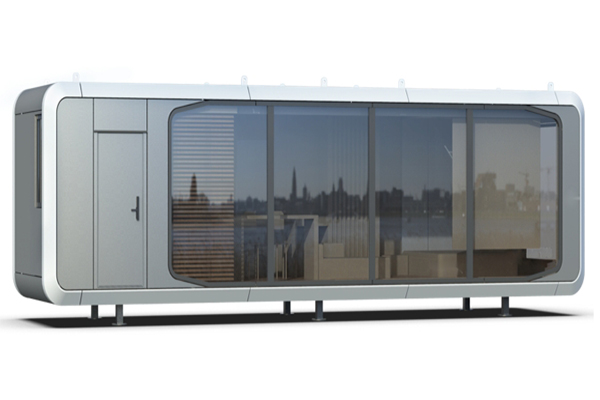

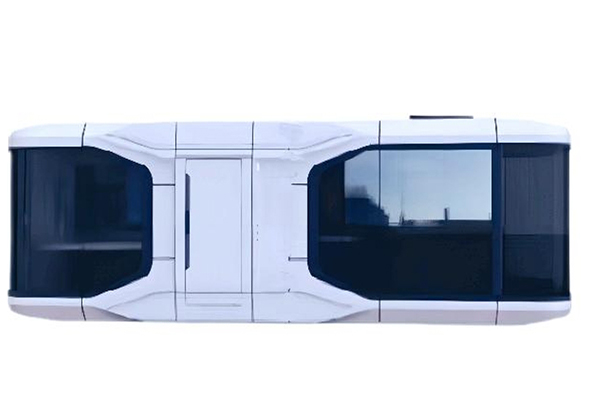
Product Link:
https://www.capsulehousemanufacturer.com/products-creative-container-house.html
As a new and green residential style, container houses are increasingly recognized by people. The emergence of container houses can be said to provide people with a new housing idea.
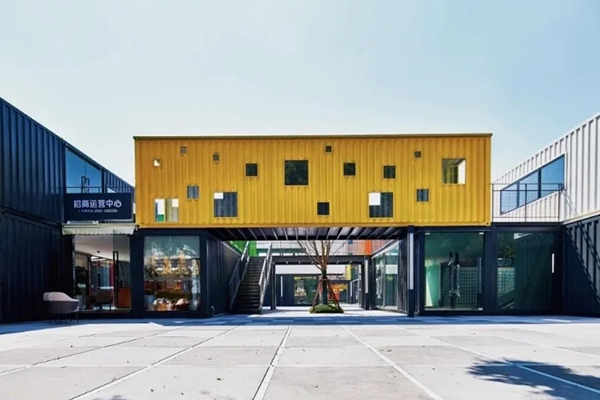
1. Precautions for customized installation of container houses:
1. Pay attention to drainage and water supply: The container is an overall iron structure. The basic work of drainage and water supply must be done well to avoid moisture in the later stage. Generally speaking, the ground terrain of the container house should be higher than the surrounding terrain, and drainage ditches should be dug around the box body. In the rainy season in summer, a "human" shaped awning should be added to the top of the container to drain rainwater. There are two main solutions to the water supply problem of the container. One is to connect to the municipal water supply system, and the other is to add a water tank. These two methods can be used in combination.
2. Pay attention to thermal insulation: Container houses are more common in providing housing for workers on construction sites. The container itself does not have thermal insulation functions. It is cold in winter and hot in summer. In summer, the outdoor temperature is 38°, and the temperature inside the container is often as high as 42°. Therefore, the thermal insulation layer is very important. After the container house is fixed, it is necessary to add a layer of sound insulation cotton and thermal insulation cotton, and install air conditioning facilities. 3. Pay attention to lightning protection: If the container house is installed in the high mountain wilderness, the iron container house is easy to become the target of lightning on a rainy day. Therefore, the installation of the lightning rod cannot be neglected. In addition to lightning protection measures, if the container house has stairs, balconies and other structures, fences should also be welded. 2. On-site assembly and hoisting of container houses: 1. Assembly: The container mobile houses of this project are all independent single rooms, assembled into a two-story dormitory form. One mobile house is hoisted and stacked on top of another, and the upper and lower two are stacked together and fixed with bolts through the 4 angle steel plates on the corners. 2. Hoisting and transportation: After the single-room container house is processed into a finished product in the factory and transported to the construction site of this project by a transport vehicle, it is hoisted to the designated location by a 15T truck crane. During hoisting, four steel wire ropes are used to fix the 4 angle steel plates on the corners with bolts. 3. Foundation requirements
This temporary residential container house needs to be designed according to the specifications. Generally, a rigid concrete foundation surface is required, and sinking or deformation and cracking are not allowed. If the foundation needs to be compacted on the backfill soil, the foundation is constructed as follows: concrete rough floor surface (compacted with plain soil, 200 thick original plain concrete surface layer, and then poured with 100 thick C20 reinforced concrete).
4. Fire prevention and equipment
1. The residential container house is made of colored steel plates with rock wool and slag wool that have fireproof and heat-insulating properties.
2. The distance between container rooms, the layout of fire passages, the fire separation, the number and layout of fire stairs, the layout and number of fire extinguishers in the site all meet the relevant requirements of the "Technical Specifications for Temporary Buildings on Construction Sites" (JGJ/T188).

3. There should be a fire passage around the container house, and the width shall not be less than 3.5m. When used as a dormitory, the fire resistance level is level 3, with a maximum of 2 floors, a maximum allowable length of 100m, and a maximum allowable area of 1200m2 per floor; 4. Fire separation distance: The distance from the warehouse of flammable and explosive dangerous goods should be greater than 25m. For container houses arranged in groups, each group shall not exceed 10 buildings, and the distance between each building shall not be less than 3.5m, and the distance between groups shall not be less than 10m.